


Scalable Logical Reasoning
Collection
A collection of scalable logical reasoning tasks • 14 items • Updated • 2
Need help to make the dataset viewer work? Make sure to review how to configure the dataset viewer, and open a discussion for direct support.
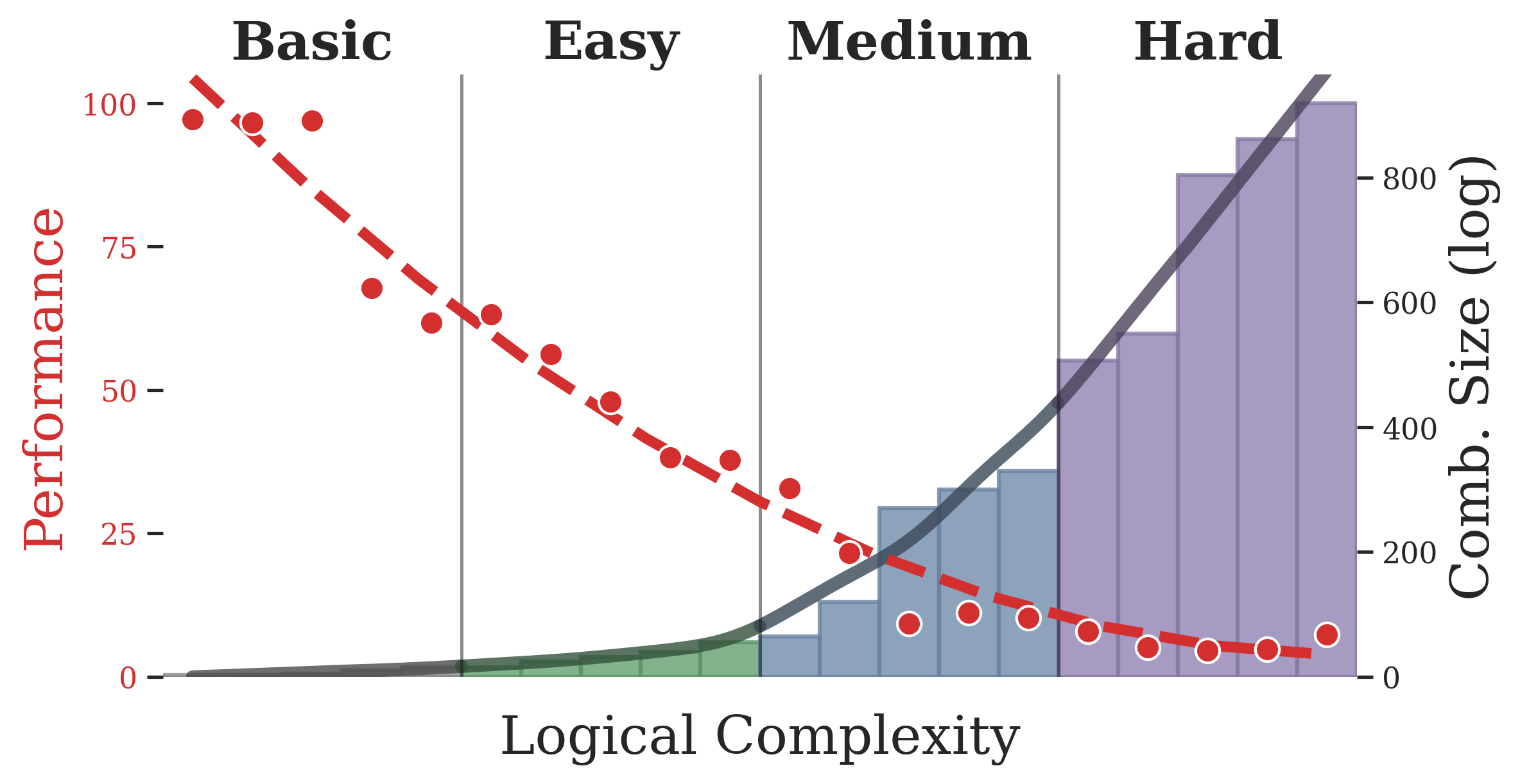









SLR-Bench-German is the German-language pendant of the original SLR-Bench dataset. It follows the same symbolic structure, evaluation framework, and curriculum as the English version but provides all natural-language task prompts translated into German.
This enables systematic evaluation and training of Large Language Models (LLMs) in logical reasoning in german, supporting both multilingual reasoning and cross-lingual generalization research.
from datasets import load_dataset
# Load SLR-Bench test split
ds = load_dataset("AIML-TUDA/SLR-Bench-German", "v1-All", split="test")
Requires the evaluate library and a Prolog interpreter installed on your system (e.g., SWI-Prolog).
Install the required dependencies via:
pip install evaluate
sudo apt-get install swi-prolog
from evaluate import load
symbolic_judge = load("AIML-TUDA/VerifiableRewardsForScalableLogicalReasoning")
rules = ds["ground-truth rule"]  # For demo only—use model predictions in practice
references = [
    {
        "validation_program": p,
        "evaluation_config": {
            "positive_predicate": "ost",
            "negative_predicate": "west"
        }
    } for p in ds["validation program"]
]

results = symbolic_judge.compute(predictions=rules, references=references)
print(results)
Note: For real evaluation, replace rules with your model's predicted rules. Here, we use ground-truth rules for demonstration only.
Example results:
{'accuracy': 1.0,
 'partial_score': 1.0,
 'syntax_score': 1.0,
 'detailed_results': [{'is_correct': True,'partial_score': 1.0,'syntax_valid': True,'error': None,'exec_time1': 0.014362812042236328},
                      {'is_correct': True,'partial_score': 1.0,'syntax_valid': True,'error': None,'exec_time1': 0.012364625930786133}]
}
| Column Name | Type | Description |
|---|---|---|
| id | int64 |
Unique identifier for each dataset entry (row). |
| prompt | string |
The instruction prompt of the logical reasoning task. |
| ground-truth rule | string |
The latent logical rule that solves the given task. |
| validation program | string |
The executable logic program used by the symbolic judge to verify candidate model solutions for the task. |
| symbols | string |
Symbolic representation of the bckground knowledge |
| curriculum level | int64 |
The specific level (1-20) in the SLR-Bench curriculum that this task belongs to, reflecting difficulty. |
| curriculum tier | string |
The broader difficulty tier grouping multiple levels (e.g., "basic", "easy", "medium", "hard"). |
| rule sampling | string |
The policy or method used to generate the ground-truth rule (e.g., "uniform", "llm-guided"). |
| rule complexity | string |
The length of the logic rule, counting the number of used predicates without the has_car predicate. |
| background sampling | string |
The policy used to sample background knowledge for the task (e.g., "mirror", "uniform"). |
| problem size | int64 |
Total number of labeled examples (positive + negative) provided in the task instance. |
| vocabulary predicates | int64 |
Number of unique predicate symbols available in the vocabulary for constructing rules and background knowledge. |
| vocabulary car constants | string |
List of car constant symbols (e.g., "car1", "car2", ...) available in the vocabulary for the task. |
| Stage | Level | #Consts | #Preds | κ (Problem Size) | Bπ (Background) | Rlen (Rule len) | Rsample (Rule Sample) | Comb. Size |
|---|---|---|---|---|---|---|---|---|
| Basic | 1 | 1 | 5 | 2 | mirror | 1 | uniform | 10³ |
| 2 | 1 | 5 | 2 | mirror | 1-2 | uniform | 10³ | |
| 3 | 1 | 5 | 4 | mirror | 1-2 | uniform | 10⁵ | |
| 4 | 2 | 5 | 4 | mirror | 1-2 | uniform | 10¹⁰ | |
| 5 | 2 | 5 | 6 | mirror | 1-2 | uniform | 10¹⁶ | |
| Easy | 6 | 2 | 5 | 6 | uniform | 1-2 | uniform/llm | 10¹⁶ |
| 7 | 2 | 6 | 6 | uniform | 1-2 | uniform/llm | 10²⁴ | |
| 8 | 2-3 | 6 | 8 | uniform | 1-2 | uniform/llm | 10³² | |
| 9 | 2-3 | 6 | 10 | uniform | 2-3 | uniform/llm | 10⁴⁰ | |
| 10 | 2-3 | 7 | 12 | uniform | 2-3 | uniform/llm | 10⁵⁵ | |
| Medium | 11 | 2-4 | 7 | 14 | uniform | 2-3 | uniform/llm | 10⁶⁵ |
| 12 | 2-4 | 9 | 16 | uniform | 3-4 | uniform/llm | 10¹²⁰ | |
| 13 | 4-6 | 9 | 18 | uniform | 3-4 | uniform/llm | 10²⁷¹ | |
| 14 | 4-6 | 9 | 20 | uniform | 4-5 | uniform/llm | 10³⁰⁰ | |
| 15 | 4-6 | 9 | 22 | uniform | 4-5 | uniform/llm | 10³³⁰ | |
| Hard | 16 | 5-6 | 10 | 24 | uniform | 4-5 | uniform/llm | 10⁵⁰⁷ |
| 17 | 5-6 | 10 | 26 | uniform | 4-5 | uniform/llm | 10⁵⁴⁹ | |
| 18 | 5-6 | 12 | 28 | uniform | 4-5 | uniform/llm | 10⁸⁰⁵ | |
| 19 | 5-6 | 12 | 30 | uniform | 5 | uniform/llm | 10⁸⁶¹ | |
| 20 | 5-6 | 12 | 32 | uniform | 5 | uniform/llm | 10⁹¹⁹ |
SLR-Bench Curriculum: level-wise configurations, detailing language and task parameters for each difficulty stage. Language complexity is systematically increased by expanding the number of car constants and predicates. Task configuration grows via adapting problem size, background sampling, rule length, and rule sampling strategy. The final column reports the approximate combinatorial size of unique tasks available at each level.
SLR-Bench is made available under the CC BY license.
If you use this dataset or framework, please cite:
@incollection{helff2025slrautomatedsynthesisscalable,
      title={SLR: Automated Synthesis for Scalable Logical Reasoning},
      author={Lukas Helff and Ahmad Omar and Felix Friedrich and Antonia Wüst and Hikaru Shindo and Rupert Mitchell and Tim Woydt and Patrick Schramowski and Wolfgang Stammer and Kristian Kersting},
      year={2025},
      booktitle ={Working Notes of the NeurIPS Workshop on Foundations of Reasoning in Language Models},
      url={https://arxiv.org/abs/2506.15787},
}